

Text-based Teaching Manual
I. Introduction to Text-Based Instruction
1. What is text-based instruction?
Text-based instruction uses texts sourced directly from target-language discourse communities to teach learners how to read texts critically, recognize features in the texts, and create their own texts.
Text-based instruction is characterized by:
- Active learner discovery | Instructors guide learners to uncover the linguistic and sociolinguistic choices made by the creators of a text (instead of teaching learners “how it’s done”).
- A meaning-oriented departure point | The meaning of a text leads the entire teaching-learning cycle (instead of starting with grammar rules and discrete vocabulary).
- Scaffolded approach to development | Learning evolves through a series of steps crafted to support learning (instead of presenting a text “all at once”).
- Supporting the simultaneous development of linguistic, cognitive, and sociocultural competencies | The three areas required for a learner to develop into a critical multilingual speaker are explicitly engaged in each step (instead of teaching grammar and culture separately from each other, and with lower cognitive demands).
2. Why incorporate text-based tasks into your curriculum?
Text-based instruction has shown to promote gains in functional proficiency for both L2 and heritage language education, more effectively than other approaches (as shown in Byrnes et al., 2010 for L2 and for heritage, ongoing research from Gatti and Graves iletc.commons.gc.cuny.edu/ipap/presentations/#GENRE-BASED). This is perhaps the primary motivation to incorporate text-based tasks into your curriculum.
Another advantage of text-based instruction is its relationship to graduation curricular goals beyond the language classroom, by way of introducing learners to literacy-oriented, cognitively challenging classroom work. This contrasts to the typical commercially-available textbooks, especially those for L2 instruction, which follow—some more successfully than others—what is known as a communicative approach to language teaching and learning. Under the communicative approach, the goal of instruction is to help learners develop interpersonal communication for transactional language use (communicating personal needs, completing transactions like ordering food at a restaurant, purchasing a train ticket, etc.). This approach is minimally cognitively challenging to learners, especially to post-secondary/adult learners. While developing that type of interpersonal communicative competence certainly must be one goal of the language learning curriculum, text-based tasks additionally allow for literacy goals that prepare learners for the academic use of language. Allowing for such academic goals accordingly allows for L2 and heritage courses to be aligned with general education/common core degree requirements, and to better address development of all the areas listed in the World-Readiness Standards (ACTFL, n.d. Alignment of the World-Readiness Standards for Learning Languages with the Common Core State Standards. actfl.org/uploads/files/general/Documents/AppendixBAlignmentCommonCoreStateStandards.pdf). For more on this advantage, see Schulz, 2006; Swaffar, 2006.
A third benefit to text-based instruction is that it allows language to be developed by engaging learners with contextualized meaning beyond the sentence level. More traditional approaches to language instruction typically use a bottom-up approach, which puts meaning—the very reason why we use language—at the end of the teaching-learning process: Grammar and vocabulary are learned first, and with these “pieces” the learner creates sentences to practice language. As it happens, this bottom-up approach has also been found, anecdotally, to be particularly confusing to heritage language learners, who enter their education with an extant intuition for many of these features, an intuition which can be thrown off by explicitly teaching such rules and patterns at the start of a curriculum. The text-based model instead uses a top-down approach: It starts with the meaning of the text, and only then do learners investigate how features are used to create meaning. To read more, check this summary about top-down approaches: iletc.commons.gc.cuny.edu/ipap/genre-based-pedagogy.
A final benefit is that text-based instruction does not arbitrarily separate language from culture. It is true that many cultural products and practices can be studied independently of language. However, in order to develop intercultural competency, learners must understand how language encodes cultural and ideological perspectives. By working with texts produced by and for specific discourse communities beyond those in the language classroom, and by carrying out the targeted text analysis (a central component of text-based pedagogies), text-based approaches explicitly show learners the culturally-informed choices made by speakers and writers when they create texts. For example, learners are shown how different speakers or writers use different language varieties, an issue that is central to all language education, but particularly to heritage language education given that heritage speakers are known for presenting a wide range of variation in the way they use language. For more on this, check the pedagogy of multiliteracy and Paesani, 2018)
In short, text-based instruction avoids the arbitrary separation of the linguistic, cognitive, and sociocultural dimensions of literacy. Instead, these dimensions are explored and developed as interconnected features for conveying meaning, while learners are explicitly taught how writers write and how speakers speak—a model that has been shown to support advancing learners’ functional proficiency development.
3. What learner goals does text-based instruction facilitate?
While goals are context specific, text-based instruction is well suited to support a few specific learning objectives. After completing a text-based task, learners will be able to:
- apply strategies to interpret the global meaning of a text sourced from target-language discourse communities.
- identify genre, linguistic, and sociocultural features of the text used in the task.
- understand that authorship is an intentional activity: the genre, linguistic, and sociocultural features found in a text result from choices made by the author(s).
- select genre, linguistic, and sociocultural features to create their own texts.
4. Where does this pedagogical approach come from?
The principles of creating a text-based task are taken from theories of language and language teaching, which can be grouped under an umbrella of “textual thinking” approaches (a term introduced by Kate Paesani, 2018). Most of these principles originate in the work of the British linguist Michael Halliday and his theory of systemic functional linguistics (SFL), and because of this, these are sometimes called “functional approaches.” A functional approach to language “looks at how language enables us to do things… It is concerned with how people use real language for real purposes” (Derewianka, 1990, pp. 3–4). This “doing” may vary from one discourse community to another, and in such a functional approach to pedagogy, learners are guided to discover the choices made by specific members of discourse communities for specific purposes.
These approaches have been in use since the 1980s and were originally developed with the goals of validating the literacy practices of children from minority groups and making the language of schooling—which typically does not integrate or recognize the language of minorities—explicit to them by making it explicit to teachers first, beyond the correction of spelling and punctuation and encouraging the learner to “try harder” (Martin & Rose, 2008, p. 1). Since then, this approach has been shown to be successful in other educational contexts as well.
One of the most influential text-based pedagogical approaches to language development is the genre-based approach from the Sydney School. The principles used to design, implement, and assess a text-based task, as described in the text-based model we introduce here, are mostly faithful to the genre-based model, only deviating from it in areas where such deviation facilitates both the training of instructors in the use of the model and the integration of tasks into an existing curriculum. For instance, the genre-based framework requires instructors to have nuanced knowledge of SFL, knowledge which is not typically part of the tool kit of most post-secondary language instructors in the U.S. Becoming acquainted with SFL entails extensive, time-consuming training which the college might not be able to afford, or in which faculty might not be interested. Instead, the version presented in this manual (which will be explained in section II) allows for working within the typical “textbook grammar” framework with which most college-level instructors have familiarity, while reframing the tasks from a literacy-, meaning-, critically- oriented fashion. Additionally, the version in this manual allows for integrating text-based tasks into existing curricula instead of redeveloping the entire curriculum on the basis of a genre-based approach, something that many programs might not be ready to do.
Learners (in and outside the classroom) are used to making meaning for specific audiences and specific purposes. One example is how our learners use language in their social media interactions: they use it for a specific purpose, to achieve something (for example, to get their friends interested in an event they are organizing) and they always have a specific audience in mind. They do this unconsciously. Compare this use of language to how learners are asked to use language in the classroom when conducting activities to practice grammar forms and vocabulary. In that case, the purpose is to practice language, and the audience is an audience “of convenience” (classmates, the instructors)—an artificial way of using language.
Learning the choices that target-language communities make in specific contexts for specific purposes is as important as learning vocabulary or word order in the new language. By implementing a functional approach in the classroom, instructors incorporate contextualized meaning, for a specific purpose, and a specific audience, which helps learners become aware of the choices they and other language users make, when using their L1 or L2, and while developing grammar and vocabulary.
5. Read more about it
5.a Advantages of working with texts in the L2 and heritage classrooms
Unless a link to the original source is included, summaries have been edited for length from existing summaries and abstracts.
Byrnes, H. (2006). Introduction to perspectives. The Modern Language Journal, 90(2), 244–246. jstor.org/stable/3876873
- This special issue is written for college-level language education and it is aimed to challenge instructional and programmatic issues alike.
Byrnes, H., Maxim, H., & Norris, J. (2010). Realizing advanced foreign language writing development in collegiate education: Curricular design, pedagogy, assessment. The Modern Language Journal, 94, i-235.
- This monograph presents in detail the genesis, design, and implementation of a full-scale curricular innovation in a U.S. university German foreign language studies program, with a primary focus on writing development. Its goal is to demonstrate and articulate how college educators, from typically diverse scholarly persuasions, might conjointly craft a much-needed response to calls for change in tertiary foreign language and cultural studies departments. It theorizes an approach to educational design that is at once theoretically grounded in genre-based literacy development, legitimately responsive to both literary-cultural and language developmental values of faculty, and practically focused on student achievement of very advanced learning outcomes.
Kramsch, C. (2006). From communicative competence to symbolic competence. The Modern Language Journal, 90(2), 249–252. jstor.org/stable/3876875
- Kramsch’s contribution focuses on symbolic competence. She voices a concern about the narrow interpretation of what collegiate foreign language teaching is all about, arguing that “Today it is not sufficient for learners to know how to communicate meanings; they have to understand the practice of meaning making itself.”
Paesani, K. (2018). Researching literacies and textual thinking in collegiate foreign language programs: Reflections and recommendations. Foreign Language Annals, 51(1), 129-139.
- This paper tackles the following questions: How can the concepts of literacies and textual thinking be applied to collegiate foreign language programs? Why is a literacies orientation important for reshaping foreign language education in the 21st century?
Rifkin, B. (2006). A ceiling effect for communicative language teaching? The Modern Language Journal, 90(2), 262–264. jstor.org/stable/3876879
- This paper suggests that addressing the lack of program coherence is where the best use of our professional energies toward renewal should be applied. To Rifkin, communicative language use, or proficiency, and intellectually valid engagement with texts and cultures, are not inherently in opposition; yet, they seem to be, because, as a field, we have not demanded the creation of extended curricula.
Schulz, R.A. (2006). Reevaluating communicative competence as a major goal in postsecondary language requirement courses. The Modern Language Journal, 90(2), 252–255. jstor.org/stable/3876876
- The paper argues that communicative competence as a pedagogical practice is neither realistic nor sufficient as a goal for collegiate language learning. Accordingly, the author challenges readers to find ways to enable learners to gain deep insights into the differences and similarities in languages and cultures, not by talking about them, but by incorporating these goals into language instruction.
Steinhart, M. M. (2006). Breaching the artificial barrier between communicative competence and content. The Modern Language Journal, 90(2), 258–262. jstor.org/stable/3876878
- This paper proposes that the underlying problem in the teaching and learning of languages at the college level is a separation of what has been called communicative competence and content. The author asks, “Could not the goals of the literature-civilization courses also incorporate those of a language sequence, and likewise, should not the content of language courses engender critical, analytical, and independent thinking?”
Swaffar, J. (2006). Terminology and its discontents: Some caveats about communicative competence. The Modern Language Journal, 90(2), 246–249. jstor.org/stable/3876874
- This paper provides a historical context of developments over approximately three decades and explains how the terminology of communicative competence has become part of the present limitations found in L2 teaching and learning. As the author suggests, a turn toward communicating “intelligently about a culture’s multiple facets” in order to engage our students “in obtaining new knowledge about content and communicating an analysis of how that content operates” might be one way to revitalize the field.
Tucker, H. (2006). Communicative collaboration: Language, literature, and communicative competence redefined. The Modern Language Journal, 90(2), 264–266. jstor.org/stable/3876880
- This paper discusses how, through notions of literacy, there seems to be a remarkable opportunity for bridging our great divides—the one within foreign language departments and the one across the humanities to English departments.
5.b The text-based model of instruction
Derewianka, B., & Jones, P. (2016). Teaching language in context (2nd ed.). Oxford University Press.
- This book is written with a K-12 audience in mind, but extremely useful for adult and young-adult language teaching and is a great introduction to genre-based language teaching. Of particular importance for those new to the approach are Chapter 1, An Appropriate Model of Language; Chapter 2, The Functions of Language; and Chapter 3, Introduction to the Teaching-Learning Cycle. In this book, you will also find chapters focused on teaching specific genres: storytelling, Chapters 4 and 5; description genres, Chapter 6; explaining genres, Chapter 7; persuasion genres, Chapter 8; responding genres, Chapter 9; and genres for inquiry, Chapter 10.
Kern, R. (2000). Literacy and language teaching. Oxford University Press.
- The audience for this book is both language researchers and teachers at all levels of instruction, and contains specific examples from college level language instruction. This book posits that literacy is an organizing principle for foreign language education, and that this is supported by key research findings in cognitive theory, sociolinguistics, discourse analysis, language acquisition, and literacy studies. The book provides an heuristic framework for teaching reading and writing as highly interrelated acts of communication, at all levels of language instruction.
Martin, J.R., & Rose, D. (2008). Genre relations: Mapping culture. Equinox.
- “This book provides an introduction to genre analysis from the perspective of the ‘Sydney School’ of functional linguistics. Chapter 1 introduces our general orientation to genre from the perspective of system and structure, and places genre within our general model of language and social context. Chapters 2–5 deal with five major families of genres (stories, histories, reports, explanations and procedures), introducing a range of descriptive tools and theoretical developments along the way. Chapter 6 deals with a range of issues arising for genre analysis in a model of this kind.” Equinox
Maxim, H. H. (2006). Integrating textual thinking into the introductory college-level foreign language classroom. The Modern Language Journal, 90, 19–32.
- This article is intended for college-level language instructors and curriculum developers. One of the characteristics of the well-documented bifurcation in collegiate foreign language instruction is the transition from lower- to upper-level instruction. Particularly pronounced are the expectations placed on readers at the upper level, who must go from surface readings and sentence-level exercises on everyday situations with clear intent and unambiguous meaning, to supra-sentential and discourse-level processing of texts that contain a significantly higher level of abstraction and ambiguity. Recognizing that preparation for such an approach to reading requires long-term attention, this article explores the pedagogical feasibility of implementing the type of textual thinking and reading practiced at upper levels into beginner-level instruction.
Multiliteracies newlearningonline.com/multiliteracies
- Multiliteracy pedagogies approaches recognize that the business of communication and representation of meaning today increasingly requires that learners are able to figure out differences in patterns of meaning from one context to another, which are the consequence of any number of factors such as culture, gender, life experience, subject matter, or social or subject domain. Because of the rise of new venues of communication, meaning is made in ways that are increasingly multimodal—in which written modes of meaning interface with oral, visual, audio, gestural, tactile and spatial patterns of meaning. This means that we need to extend the range of literacy pedagogy so that it does not unduly privilege alphabetical representations, but brings into the classroom multimodal representations, particularly those typical of digital media.
Paesani, K. (2018). Researching literacies and textual thinking in collegiate foreign language programs: Reflections and recommendations. Foreign Language Annals, 51(1), 129–139.
- This article reflects on the literacy turn in collegiate foreign language (FL) programs, taking as its central argument that the focus in foreign language curriculum, instruction, and research should not be on the content we teach, be it language, literature, or culture, but rather on textual thinking and literacy development.
Rose, D. (2021). Literacy education and systemic functional linguistics. In S. Conrad, A.J. Hartig, L.Santelmann (Eds.), The Cambridge introduction to applied linguistics (pp. 115–132). Cambridge University Press.
- This chapter outlines an approach to teaching spoken and written language that has been developed over many decades in the research tradition of systemic functional linguistics (SFL), known as genre-based literacy pedagogy. The term genre refers to the ways that texts vary according to their social purposes. The chapter starts with the SFL model of text-in-context. It then introduces analyses of two sets of genres found in educational curricula: “knowledge genres” (such as stories, explanations, procedures, arguments) and “curriculum genres” (genres of classroom teaching and learning). Genre pedagogy is then exemplified with extracts from a science literacy lesson.
Troyan, F.J. (2020). Genres in contextualized world language assessment and learning. In F.J. Troyan (Ed.), Genre in world language education (pp. 3–31). Routledge. doi.org/10.4324/9780429321009
- This book is intended for future and current L2 and heritage language teachers and instructors at all levels of instruction. In line with ACTFL and CEFR standards, and following a theoretically-informed instructional framework, this volume brings together scholarship on contextualized, task-based performance assessment and instruction with a genre theory and pedagogy to walk through the steps of designing and implementing effective genre-based instruction.
Zapata, G.C. (2022). Learning by design and second language teaching: Theory, research, and practice. Routledge. doi.org/10.4324/9781003106258
- An introductory chapter presents the theoretical tenets of the multiliteracies approach and is followed by four chapters establishing of connections between the framework and L2 instruction, information on evidence-based pedagogical practices and suggestions for their implementation, and task examples that can be adapted for use in a variety of educational contexts.
II. Creating a Text-based Task for the Second- or Heritage Language Class
II.1 Key concepts
1.a What is a “text”?
Text-based instruction uses texts sourced directly from target-language discourse communities to teach learners how to read texts critically, recognize features in the texts, and create their own texts.
In the context of text-based task pedagogy, “texts” are broadly defined as any form of human communication in any modality or combination of modalities. So, for example, a movie, a song, a picture, a message written on a postcard, and a spontaneous dialogue between friends are all texts.
However, since a key aim of college education is developing academic literacy, this manual focuses on texts of which writing is either the primary modality or is key to understanding it. This manual also does not focus solely on literary texts, like poems, short stories, and plays. Instead, a variety of genres and purposes are included, some artistic and some not, such as the caption to an Instagram picture, a recipe, a graphic novel, a Wikipedia page, a tweet, the wall label in a museum, the instructions for an electronic device, etc.
1.b Which texts to use in text-based instruction and why
The text is the starting point of text-based instruction. Instead of selecting a text crafted for a second or heritage language learner enrolled in a language class, this pedagogy calls for selecting texts created by members of a target-language discourse community for members of the same discourse community. A discourse community could coincide with national borders or not, as many texts are created for and by a collection of discourse communities, sub-communities, or social institutions such as friends, family, book clubs, sporting groups, universities, etc. (adapted from Derewianka & Jones, 2016, p. 7).
Why should we select these types of texts? A text-based pedagogy approach seeks to teach learners how to interact with texts they could or eventually will find outside the classroom, where the language they are developing lives “in the wild.” While working with such texts can be challenging for learners, this type of intellectual effort is welcome in and appropriate for the post-secondary classroom, and teaches learners the strategies needed for accessing the meaning (linguistic and sociocultural) of such texts. These texts also hold the cues (again, both linguistic and sociocultural) that learners need to be able to produce their own texts.
To select the text for a text-based task, the pedagogy relies on two key concepts: genre and register.
1.c What is genre?
Every text we use in communication displays distinct characteristics. Most of the time, these characteristics mean that we only need a quick glance at the text to immediately know/guess what the text is, what it was written for (its purpose), and the context in which it might be found. Consider the three written texts below:


These three texts—a shopping list on a smartphone, a label posted next to an art piece, possibly in a museum, a fairy tale possibly found in an anthology—share one modality; they are all written. However, they have distinct purposes. That difference is signaled by the ways they are structured and by sets of “textual features” in the composition of each one.
The structure of the shopping list, if changed from a list of words to a paragraph or sentences, would not be as effective for the purpose of rapidly identifying items when shopping. Alternatively, the structure of the museum label of an art piece often needs a few sentences or a short paragraph in order to provide key information for quick reading. Finally, the structure of even the shortest of fairy tales relies on a series of connected paragraphs; there will typically be a “beginning” setting the stage for the story, probably followed by the introduction of a conflict, followed by a resolution of this conflict, and an ending.
In terms of the textual features, for a shopping list the author will primarily rely on the use of nouns, while for a museum label the author resorts to using many linking verbs (to be, to seem, to have, to look like), and the author of the fairy tale relies on time markers to create sequential events. The level of accuracy expected will also vary by genre (as we see in the shopping list).
Additionally, choices are also made depending on the medium where the text appears (smartphone, museum wall, anthology), and the target audience of the text. For instance, art labels in an exposition for adult audiences look very different from labels in an exposition designed for an audience of school-age children.
Finally, we should not assume that all discourse communities choose similar text organization or/and similar textual features to construct texts that seem to have similar purposes. For instance, a high school academic essay might look noticeably different if produced by highschoolers in Chicago, highschoolers in Taipei, or highschoolers in rural Russia. Genres are socially- and culturally-situated processes which evolve through time (much as language does). For L2 or heritage language instructors, this fact is particularly relevant as it makes evident that linguistic choices and intercultural competence are interlaced.
All the decisions made by a speaker/writer/signer when composing a text are captured in the definition of genre provided by Martin and Rose in their 2008 book Genre relations: Mapping culture (p. 6), as goal-oriented, staged, social processes:
- Genres are goal-oriented because they have evolved to get things done; for example, the goal of a biography is to tell a life story, the goal of a typology is to classify differences, etc.
- Genres are staged because it takes more than one step to reach the genre’s goal. A story is not told “at once” but through several stages: First, key background information is introduced to orient the reader, then a series of chronological events are used to develop the story, etc.
- Genres are social processes because they are co-constructed by members of specific discourse communities: genres are created and shaped by users themselves. As such, they are pervious to all the influences social processes are pervious to (change, attribution of value, etc.).
Practitioners working within functional linguistics have developed genre taxonomies for the genres used by their discourse communities or/and the genres typically taught in school. These taxonomies help us understand what those communities typically use genres for and how they structure prototypical genres, making the teaching of texts more transparent to learners. One example of a genre taxonomy is below, in Table 1:
Table 1. Example of a partial genre taxonomy. Adapted from Rose, D. (2021). Literacy education and systemic functional linguistics. In S. Conrad, A. Hartig, & L. Santelmann (Eds.), The Cambridge introduction to applied linguistics (pp.115–132). Cambridge University Press.
| Genre Family | Genre Name | Genre Purpose | Genre Stages |
| Stories | Recount | Recounting events | Orientation |
| Events | |||
| Narrative | Solving a complication | Orientation | |
| Complication | |||
| Resolution | |||
| Exemplum | Judging character or behavior | Orientation | |
| Complication | |||
| Evaluation | |||
| Anecdote | Sharing an emotional reaction | Orientation | |
| Complication | |||
| Evaluation | |||
| Chronicles | Autobiographical recount | Recounting life events | Orientation |
| Life events | |||
| Biographical recount | Recounting life stages | Orientation | |
| Life stages | |||
| Historical recount | Recounting historical events | Background | |
| Historical stages | |||
| Historical account | Explaining historical events (cause and effect) | Background | |
| Historical stages | |||
| Explanations | Sequential explanation | Explaining a sequence | Phenomenon |
| Explanation | |||
| Conditional explanation | Alternative causes and effects | [Phenomenon] | |
| Explanation |
In summary, the concept of genre is key to text-based pedagogy, as learners are taught to recognize the features (both structural and textual) a speaker/writer/signer has selected, and how to use this information to make their own socio-culturally-informed choices to create their own texts.
In the next sections, we address some key dimensions involved in text selection using concepts related to genre, register and context.
II.2 Implementing a text-based task: The teaching and learning cycle (TLC)
2.a What is the Teaching and Learning Cycle (TLC)?
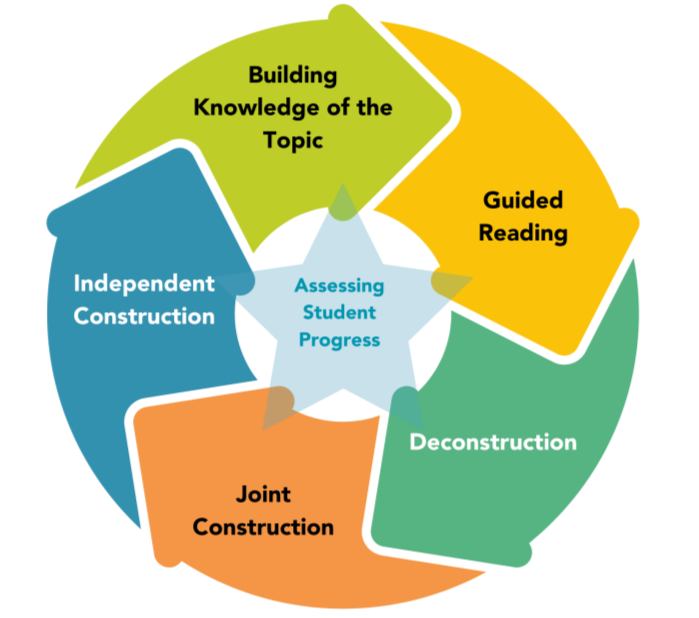
This manual adopts a version of a teaching and learning cycle (TLC) inspired by the work of Beverly Derewianka (see victesol.vic.edu.au/wp-content/uploads/A-Teaching-and-Learning-Cycle.pdf). This TLC has five steps (which will appear capitalized in this document for easy identification): Building Knowledge of the Topic, Guided Reading, Deconstruction, Joint Construction, and Independent Construction. Where Steps 1 and 2 focus on learning objectives related to decoding meaning/accessing content, Step 3 focuses on objectives associated with understanding genre and its purpose and how this purpose is realized through language. Steps 4 and 5 are centered on creating meaning/content.
Table 2. The Text-based Task (TLC) and Learning Objectives
| TxBT TLC Steps | Learning objectives related to | |
| Step 1 | Building Knowledge of the Topic | Decoding meaning/accessing content |
| Step 2 | Guided Reading | Decoding meaning/accessing content |
| Step 3 | Deconstruction | Understanding the purpose of the genre and how purpose is realized through language |
| Step 4 | Joint Construction | Creating meaning/content |
| Step 5 | Independent Construction | Creating meaning/content |
At the core of this cycle is the continuous assessment of learners’ global comprehension and progress (represented by the star in the middle of the image in Figure 1, below). This continuous assessment could be done in a variety of ways, depending on the step on which you are working (more on this will be provided shortly, in Section II.2.d.)
Figure 1. The Teaching and Learning Cycle for a Text-based Approach

Even if the work is recursive, for pedagogical purposes, we describe the steps linearly, starting with the three steps that stress interpretation, followed by steps that stress production. For the first three steps, the starting point of all activities is the chosen text. To illustrate the steps, we are using a text-based task for a third-semester Italian L2 class. The task and chosen text have been translated into English to make the approach clear to instructors of any language (you can read and download the complete task in this Repository [textbasedtasks.commons.gc.cuny.edu/2024/05/10/biography-genre-task-english-l2-nh-im-tinto]):
- Genre | biographical recount (a text that tells, in chronological order, the facts of someone’s life)
- Text | short biography of an Italian Renaissance artist (Tintoretto, taken from kids.britannica.com/students/article/Tintoretto/277365 and pasted below for reference)
Tintoretto
(1518?–94). The energy and excitement of the Renaissance radiate from the paintings of the Italian master Tintoretto. Dramatic composition and the bold use of changing light make his work unique.
Little is known of Tintoretto’s life. He was born Jacopo Robusti in Venice in about 1518. His father worked as a tintore, or dyer of cloth, so Jacopo became known as Tintoretto, “little tintore.” Tradition says his heroes were the painters Michelangelo and Titian, but Tintoretto early developed a distinctive style.
His treatment of light and shade was as vivid as lightning flashing amid storm clouds. His skill in composition created images of vast space crossed with strong curves and angles with subjects arranged in ways unusual for the period. For example, in The Last Supper, Jesus, the apostles, and angels are all present; however, the figures that are prominent in the foreground are humble serving people and domestic animals who seem unaware of the religious significance of the event.
At first Tintoretto had difficulty finding work, but gradually his reputation grew. In 1547 he was commissioned to paint scenes from the life of St. Mark, the patron saint of Venice. The first of these is the exuberant St. Mark Freeing the Slave, which made him a center of attention. By 1555 he was famous and quite popular. He began a decade of work in the decoration of the church of the Madonna dell’Orto.
In order to compete for work in the school of St. Roch, Tintoretto secretly mounted his sample on a ceiling of the school and unveiled it as if it were a finished product. He won the competition and began two decades of work in the school.
Tintoretto painted not only religious subjects but also portraits and scenes from myth and fable. Among his finest works are Presentation of the Virgin in the Temple (1552), Cana Wedding (1561), and Crucifixion (1565). Tintoretto died in Venice on May 31, 1594.
2.b The five steps of the Teaching and Learning Cycle (TLC)
STEP 1 | BUILDING KNOWLEDGE OF THE TOPIC
During this step, the instructor works with learners in a series of preparatory tasks that familiarize learners with the topic and key vocabulary to ensure that all learners can collaboratively participate in the discussions that are at the core of Steps 2, 3 and 4. In this example (the short biography of an Italian Renaissance painter), Step 1 entails first introducing the learners to the topic of Renaissance art, as well as providing some vocabulary to talk about it.
Learning objective | After working on this step, learners will be able to recall, select, and label background information and vocabulary related to the model text topic.
How it’s done | A topic introduction typically proceeds from more general to more specific information. In the case of this text, this process starts with getting learners acquainted with the Renaissance period of history, then the Italian Renaissance, then the work of the specific artist who is the focus of the selected text. Depending on the learners’ proficiency level and previous knowledge of the topic, this portion of the cycle takes advantage of the learners’ bilingual range by switching back and forth from dominant to target language. Sample tasks for introducing learners to the field are:
- Lecture supported by visuals
- Timelines
- Matching images to words
- Matching descriptive sentences to images
- Creating conceptual maps
STEP 2 | GUIDED READING
During this step, the instructor works with learners on reading comprehension of the selected text, introducing them to strategies for understanding a text they might find in or outside the classroom. Depending on the learners’ level(s), this step includes contextualizing the text (such as explaining where it was published or produced).
Learning objective | After working on this step, learners will be able to (i) access the selected text’s meaning (in this example, the short biography) and (ii) apply strategies for understanding similar texts.
How it’s done | Typically, two tasks build up to this meaning-comprehension step:
- First, learners are guided toward gaining global comprehension of the text’s content—the basic who, what, when, and where of the text’s content. For instance, in this case of the biographical recount of an Italian Renaissance painter, this might mean understanding who the biography is about, what is discussed, what time period it refers to, and where the events are taking place.
- Second, the instructor may choose to employ tasks to deepen comprehension and, depending on the language proficiency level and background knowledge of the learners, provide more opportunities for exposure to the topic and targeted vocabulary. Some of these tasks could include skimming the text, scanning for specific information, or summarizing content.
STEP 3 | DECONSTRUCTION
During this task, the instructor guides the learners through identifying the purpose of the selected text and how this purpose is achieved through language, shifting from focus on the text’s content (or field, Steps 1 and 2). This is a hallmark of any genre-based model, and notably different from what is typically done in more well-known models of L2 instruction. Because of that, this description of Step 3 includes more detail than was provided for Steps 1 and 2.
Learning objective | After working on this step, learners will be able to identify and talk about (i) the purpose of the model text, and (ii.a) the organizational features and (ii.b) the textual features through which this purpose is realized.
How it’s done:
- Genre and purpose: First, the instructor discusses with learners what genre the model text belongs to and what the purpose is in using this genre. For instance, in the case of the model text “Tintoretto,” this text is a short biographical recount that is typically used to get a quick (not in-depth) acquaintance with a historical figure, like might happen in an encyclopedia entry designed for readers looking to obtain quick facts. The use of Socratic questions (“guiding questions”) is a valuable pedagogical tool here; for instance, “What do you think this text is intending to do/be used for?” “What makes you think this?” “Who might find this text useful, and why?”
- Genre stages (or “parts”): Second, the instructor guides learners in identifying the genre stages and what each of these stages is achieving (purpose). Since genres by definition are “staged,” it takes several “moves” to reach a goal and learners are going to work to identify those moves/stages. While names for stages have been proposed by specialists in genre theory (see Table 1 in Section II.1.c) it is advisable not to impose the names of stages on learners (for example, the Orientation which sets the stage by recounting birth, family, and early life, followed by the Life stages which includes the more “famed” events of the person’s life). Instead, while guiding them toward a discovery of what the text is doing; allow them, as a group, to propose the names that best identify the stages. Table 3, below, shows an example of such learner decisions that have been entered collaboratively into a checklist created by the instructor and students during the Deconstruction step.
- Textual features: Third, and once learners have a clear idea of the general structure of the text, the instructor guides learners through uncovering the language choices made by the text’s author. The features are typically preselected by instructors because it is not usually possible or advisable to look at all the features used in the selected text. Selection will depend on learners’ proficiency level. A few features that can be identified in the short Tintoretto recount are: the use of time markers to organize events (typical of all types of stories), the use of the historic present to convey perfective actions, and the use of descriptive words to characterize the particular painter style. As with genre stages, a helpful pedagogical strategy is to collaboratively organize the features uncovered in a checklist such as the one below in Table 4.
Table 3. Genre stages checklist of the text Tintoretto
| Stage | Purpose | Evidence from the text | |
| Title | Indicates who the biography is about | This title has just one word: “Tintoretto” | |
| Introduction (a.k.a. Orientation) | Identifies the characteristics of Tintoretto’s painting style | “The energy and excitement of the Renaissance”; “dramatic composition and bold use of changing light” | |
| Life events | Early life | … | … |
Table 4. Textual features checklist of the text Tintoretto
| Feature | Evidence from text |
| Chronological sequence markers | Early developed…; at first…In 1518… |
| Descriptive words | energy and excitement, bold, changing, unique, distinctive… |
| Use of tenses | Past tense for the painter’s life events; present tense for the description of his works of art |
The advantage of constructing checklists like these is that they will be easily available to learners for the next steps (Step 4, Joint Construction, and Step 5, Independent Construction), during which they will be asked to create texts. With a few modifications, these can be converted to a checklist for the learners’ writing tasks (Steps 4 and 5), and additionally, will function as a rubric for assessing the writers’ work after Step 5.
During this step, learners will also develop the shared metalanguage necessary to talk about the text (how to name the genre, the different stages, and the features). This metalanguage does not need to come from any text or textbook—you can choose terms that work for you. The goal is for the terminology of the metalanguage to be grasped and retained by both you and your learners.
On a final note, if time permits, learners benefit from deconstructing more than one model text on the same topic and genre, and with a focus on similar textual features, before moving to Steps 4 and 5.
STEP 4 | JOINT CONSTRUCTION
During this step, learners and the instructor collaboratively create a text in the same genre as the one for the deconstructed text.
Learners’ goal | After working on this step, learners will be able to (i) identify the steps taken to create a text, and (ii) produce a text of the same genre as the model text they previously deconstructed (in other words, a short biographical recount).
How it’s done | Learners are asked to prepare at home by gathering information on a specific topic (such as the life of Veronese, another Italian Renaissance painter). In class, with the information gathered (when Veronese was born, where he lived, etc.), and using the information about genre and features gained during Step 3, Deconstruction, which can be visualized in a checklist (see Tables 3 and 4 above), the instructor guides the learners in the construction of a new text. The instructor can scaffold the work by asking guiding questions regarding genre, stages or textual features, such as “What would we write in the ‘Early life’ stage achieve the goal of this stage?; “What features can we use to organize the events in chronological order within the Life events stage?”; “Could we say that in fewer words?”; “How about we move this sentence from there to here?” During this joint text creation, the instructor can ask learners to use the metalanguage they acquired/created, such as “What’s a more appropriate technical term for that?” and, finally, recasting as necessary (“You mean …?”) (For more examples of guiding questions, see Derewianka, B. (1990). Exploring how texts work. Primary English Teaching Association, p. 8).
This is a great opportunity for the instructor to assess the learners’ ability to identify and apply features from the checklist. If gaps are identified, the instructor can go back to the model text as indicated by the circular representation of the teaching-learning cycle.
STEP 5 | INDEPENDENT CONSTRUCTION
Now it is time for learners to create a text of their own, independently.
Learning objective | After working on this step, learners will be able to apply all the resources gathered in steps 1–4 in the construction of their own text related to the selected topic (for example, the Renaissance), in the target genre (for example, a biographical recount).
How’s it’s done | Now, learners are told that they are in the driver’s seat and are going to make decisions as all writers do. They are directed to the resources they have at their disposal: Both to help them and to make them accountable, learners can use the tables created during the Deconstruction (Step 3; Tables 1, 2, 3, and 4) to guide them in this process. Aside from these tools, it is important to give learners a checklist (an example is below in Table 5), showcasing all the necessary stages and textual features the learners should consider while writing independently. These are the same features addressed during Steps 3, Deconstruction, and 4, Joint Construction. The items in the checklist are expressed in the first-person singular voice, similar to the NCSSFL-ACTFL Can-do Statements, and explained using the same metalanguage the learners created and acquired during the Deconstruction. A version of this checklist can also be used as a summative assessment rubric (see Section 2.d, below).
Table 5. Example of a checklist that the learners can use during and after writing
| Tasks | Not yet | Getting there | Done | |
| Stages | I added a title that gives a glimpse into the artist’s style. | |||
| I wrote an Early life stage where I set the stage by recounting the birth, family, and early life of this person. | ||||
| I wrote Late works/established artist stage where I explore the major works of the artist, those works that made him famous. | ||||
| I wrote a Style stage where I recounted the key features of the artist’s style. | ||||
| Features | I used expressions of time and place to organize the events chronologically and geographically. | |||
| I used the appropriate vocabulary related to art to write about a painter and their work. | ||||
| I accurately used presente storico to write about the artist and their work, using doing verbs and linking verbs. | ||||
| I appropriately linked events with transition words that express cause-effect relationship. | ||||
| I expressed the relevance and lasting impact of the artist, using evaluative language and feeling verbs. | ||||
2.c Completing the five steps
How much time is needed to complete such a TLC depends on general contextual factors—such as curricular and programmatic goals and learners’ profiles—as well as some factors that are more specific to the task itself, such as text length and complexity (how many stages it has, what textual features are used, its level of formality, etc.). As with most literacy-oriented activities, taking time for learners to discover what the text is doing and how—instead of telling them up front—results in a more fruitful road towards development in many areas: cognitive, linguistic, and sociocultural. Furthermore, research has shown that the more texts of the same genre learners work with, the more they develop these linguistic, sociocultural, and critical skills, becoming better readers and writers.
2.d Assessing learner progress
As mentioned earlier, and as is represented in the visual diagram of the TLC (on section 2.a), assessment should be ongoing, and learners should actively participate in the process. Include a variety of assessments throughout the TLC. For instance, it makes sense to use formative assessments (generally low stakes, used to identify what is working and what is not, where learners are in terms of abilities, and to monitor their development) after steps 1–4. You can combine self-assessment and instructor-generated tools. A self-assessment tool for Step 1 (Building Knowledge of the Topic) might look like Table 6, below:
Table 6. Example of a self-assessment rubric
| Check one box of the three for each row -> | …with a lot of help. | …with some help. | …Independently. |
| I can select and label key information from sources… | |||
| I can convey information about the targeted topic using vocabulary that is topic-specific… |
An instructor-generated assessment tool for step 2 (Guided Reading) might look like Table 7, below:
Table 7. Example of an instructor-generated assessment rubric for working on a text at Advanced Low-Mid level of proficiency
| Intermediate Low-Intermediate Mid learners can… | Intermediate High–Advanced Low learners can… | Advanced Mid learners can… | Advanced High–Superior learners can… | |
| Ability to Access the Text’s Meaning | …access the overall, basic meaning of the text with assistance from the instructor and peers. | …access the fundamental meaning of the text with some assistance from the instructor and peers. | …access the fundamental meaning of the text independently. | …access the fundamental meaning of the text independently. |
| Ability to Understand Linguistic Nuances | …move beyond the basic text meaning to understand linguistic nuances such as word play, irony, humor, etc. | …understand some nuances in meaning such as word play, irony, humor, etc. when explained by the instructor explicitly. | …move beyond the basic text meaning and understand some of the linguistic nuances such as word play, irony, humor, etc., some of the time. | …move beyond the basic text meaning and understand most linguistic nuances such as word play, irony, humor, etc. |
| Ability to use Strategies for Understanding Texts (applying information about genre from the context of the publication) | …not use strategies for understanding target texts. | …use some strategies for understanding target texts. | …The learner is able to use strategies for understanding target texts independently most of the time. | …The learner is able to use strategies for understanding authentic texts independently. |
Summative assessments (high-stakes assessments used to evaluate learning at the end of an instructional unit by comparing it to a benchmark), are better left for step 5, after learners create their own text using what they developed throughout the entire task. A sample rubric for evaluating learner development is shown below in Table 8:
Table 8. Sample summative rubric for the “Tintoretto” text Teaching-Learning Cycle
| Task | Achieved | Partially achieved | Not achieved |
| The learner created a title that gives a glimpse into the artist’s style. | |||
| The learner wrote an Early life stage where stage of the short biography is set by recounting the birth, family, and early life of the artist. | |||
| The learner wrote a Late works/established artist stage where the major works of the artist are explored. | |||
| The learner wrote a Style stage where key features of the artist’s style are recounted. | |||
| The learner used expressions of time and place to organize the events chronologically and geographically. | |||
| The learner used vocabulary related to art to write about a painter and their work. | |||
| The learner accurately used presente storico to write about the artist and their work, using “doing” verbs and linking verbs. | |||
| The learner appropriately linked events with transition words that express cause-effect relationship. | |||
| The learner expressed the relevance and lasting impact of the artist, using evaluative language and “feeling” verbs. |
One thing to note is that every learning objective identified for a TLC step must be assessable (there must be a way for learners to demonstrate if they can or cannot do what the learning objective states) and the instructor should clearly indicate to the learner how those learning objectives are being assessed.
Finally, L2 and heritage courses typically enroll learners with varied proficiency levels. Because of this, differentiating instruction is essential to avoid unfair evaluation of some of the learners.
III. Glossary of Key Terms
Glossary
Discourse community: groups of speakers (readers, writers, signers, etc.) who share interests, and/or values, and/or experiences, and/or ideals, etc. such as sporting groups, theatre aficionados, book clubs, friends, and family. In this sense, larger units like national ones, are also discourse communities. (Adapted from Derewianka & Jones, 2016, page 7)
Genre: Goal-oriented social practices that have evolved in our culture to enable us to get things done.” Derewianka, & Jones, 2016, page 7.
Guiding questions: Socratic questions an instructor asks in order to help learners discover features in a text.
Language (according to Systemic Functional Linguistics): a meaning-making system through which users interactively shape and interpret their world and themselves. (Adapted from Derewianka & Jones, 2016, page 3)
Literacy: “The use of socially-, historically-, and culturally-situated practices of creating and interpreting meaning through texts. It entails at least a tacit awareness of the relationships between textual conventions and their contexts of use, and ideally, the ability to reflect critically on these relationships. Because it is purpose-sensitive, literacy is dynamic—not static—and variable across and within discourse communities and cultures. It draws on a wide range of cognitive abilities, on knowledge of written and spoken language, on knowledge of genres, and on cultural knowledge.” Kern, R. (2000)., p. 16.
Text: Any form of human communication in any modality (spoken, written, signed, visual, etc.) or combination of modalities.
Textual features: Any resource used by the creator of the text that results in a particular effect. Most typical textual features taught in a language classroom are “lexico-grammatical,” a term coined by Michael Halliday, the father of Systemic Functional Linguistics (SFL), to describe the continuity between grammar and lexis (vocabulary) emphasizing that vocabulary and grammatical structures are interdependent.

This entry is licensed under a Creative Commons Attribution-NonCommercial-ShareAlike 4.0 International license.

